
Safer, Faster Commercial Roof Assessments by Drone
Drone roof inspection delivers faster, safer, and more detailed assessments than traditional methods — no ladders, no climbers, no liability exposure from personnel accessing rooftops. For property managers, insurance adjusters, and roofing contractors, drones eliminate fall risks while providing better documentation than walking inspections can deliver.
Our certified pilots capture high-resolution visual and thermal imagery of commercial rooftops, giving you the data you need for insurance claims, preventive maintenance planning, and damage assessment after storms or other events. Whether you’re managing a single building or a portfolio of commercial properties, drone inspections reduce costs, accelerate timelines, and improve decision quality.
What We Deliver
Orthomosaic roof maps creating full overhead composite imagery of the entire roof surface. Orthomosaics provide uniform coverage and accurate measurements, supporting roof area calculations, material quantity estimates, and detailed damage documentation for insurance claims.
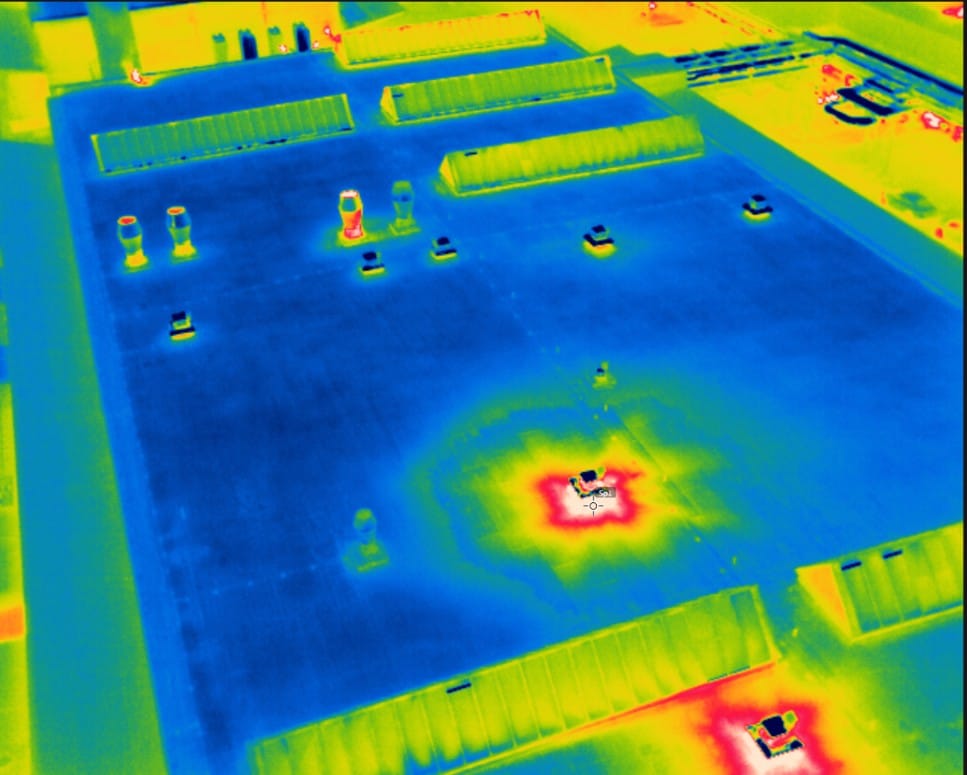
Thermal imaging to detect moisture intrusion, heat loss, and insulation gaps using calibrated infrared cameras that reveal temperature differentials invisible to visual inspection. Wet insulation shows up as cool spots where evaporative cooling occurs. Missing or damaged insulation appears as warm areas where conditioned air escapes. Early detection prevents small leaks from becoming major problems.
Damage identification including hail impacts, wind damage, ponding water, membrane deterioration, flashing failures, and fastener back-out. We document conditions with annotated imagery showing damage location, extent, and severity — critical information for repair scoping and insurance claim substantiation.
Detailed inspection reports with annotated imagery, organized by roof section and damage type. Reports include measurements, severity classifications, and recommended actions based on observed conditions. For insurance claims, documentation meets adjuster requirements for claim processing.
Why Roofing Professionals Choose Drones
Traditional roof inspections require accessing the roof surface — climbing ladders, navigating parapets, and walking across membranes that may be damaged, slippery, or structurally compromised. The safety risks are real. Falls from commercial buildings result in serious injuries and fatalities every year.
Liability concerns compound the risk. Property owners face exposure when contractors or adjusters access rooftops on their property. Insurance carriers worry about adjuster safety. Roofing contractors factor fall protection and safety training costs into every bid.
Drone roof inspection eliminates these concerns. Pilots operate from the ground, capturing complete roof coverage without anyone accessing the roof surface. Fall risk disappears. Liability exposure from rooftop access vanishes. The inspection happens faster too — what takes an hour to walk and document manually takes minutes with a drone.
The data quality is superior. Thermal imaging reveals subsurface moisture that walking inspections miss entirely. Orthomosaic maps provide comprehensive coverage — traditional inspections document sample areas and extrapolate conditions across the roof. Drones capture every square foot.
Timing flexibility matters for insurance work. After major hail or wind events, adjusters face backlogs of claims requiring roof assessment. Deploying drones accelerates the process, completing inspections in minutes instead of the hour-plus traditional methods require. More claims processed per day means faster settlements and better customer service.
Ideal For
Property managers and building owners responsible for maintaining commercial buildings, needing periodic roof condition assessments to budget capital improvements and prioritize preventive maintenance.
Insurance adjusters and claims teams documenting damage after storms, assessing claim validity, and quantifying loss for settlement purposes. Drone documentation provides objective evidence supporting claim decisions.
Roofing contractors scoping repair jobs, measuring roof areas, identifying damage extent, and developing accurate material quantity estimates before bidding projects. Better data leads to more accurate bids and fewer change orders.
Post-storm damage documentation for property owners filing insurance claims or property managers assessing portfolio-wide damage after hail, wind, or other weather events affecting multiple buildings.
Our Approach
Our pilots follow documented safety protocols on every flight, coordinating with property managers to ensure safe operations around building occupants and nearby traffic. We’re fully insured with coverage appropriate for commercial property work, FAA Part 107 certified, and equipped with thermal cameras and high-resolution visual sensors designed for building inspection applications.
Flights happen quickly with minimal disruption to building operations. We coordinate timing to avoid conflicts with tenant activities and schedule thermal imaging during optimal conditions when temperature differentials reveal moisture issues most clearly.
Deliverables include visual orthomosaics, thermal imagery, annotated damage maps, and detailed inspection reports. For insurance claims, we provide documentation formatted to meet adjuster requirements. For maintenance planning, reports include severity classifications and recommended action timelines.
The business case is straightforward. Eliminating rooftop access eliminates fall risk and associated liability. Thermal imaging detects problems early when repairs are minor instead of waiting for leaks to cause interior damage. Accurate measurements reduce material waste and change orders. For most applications, the ROI is immediate — faster, safer, and more accurate than the alternatives.
Explore our other inspection services: cell tower inspections, utility inspections, solar panel inspections, wind turbine inspections, and agricultural drone services.
Deliverables support claims documentation per ITEL and insurance carrier requirements. All pilots hold FAA Part 107 certification.