
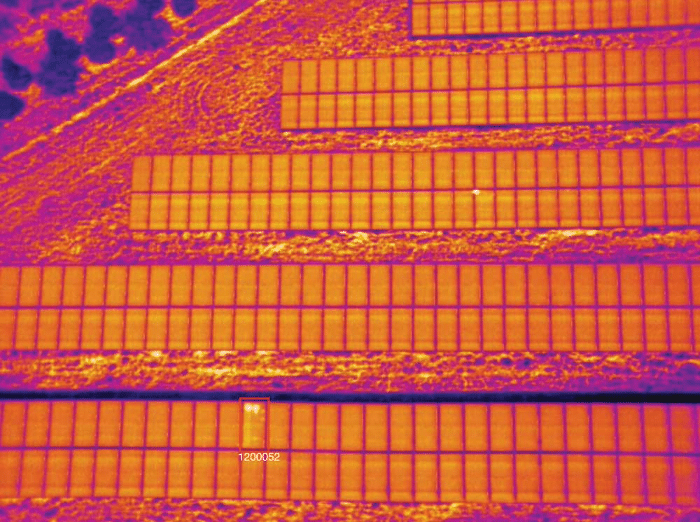
Thermal and Visual Solar Array Inspections by Drone
Underperforming solar panels cost you money every day they go undetected. Drone solar panel inspection identifies issues across an entire array in a fraction of the time it takes to inspect on foot, using calibrated thermal imaging that reveals problems invisible to visual inspection alone.
Our pilots fly calibrated thermal and RGB sensors over your solar installation, capturing the data needed to pinpoint hotspots, cell defects, and connection failures — all without shutting down production. For utility-scale solar farms spanning hundreds of acres and commercial rooftop arrays covering tens of thousands of square feet, manual inspection methods simply can’t compete with the speed and coverage drones provide.
What We Deliver
Thermal imaging to detect hotspots, diode failures, and cell damage using radiometric thermal cameras that capture precise temperature measurements across every panel in your array. Failing cells and bypass diode issues appear as temperature anomalies — we identify them, classify severity, and provide GPS coordinates so your maintenance crews can locate problems immediately.
Visual inspection for cracked panels, soiling, and physical damage, documenting surface defects, bird damage, hail impacts, and other conditions that reduce output or create long-term reliability concerns. High-resolution RGB imagery captures details down to individual cell level.
Full-array orthomosaic maps with GPS-tagged anomalies, creating a complete visual and thermal record of your installation. Orthomosaics provide uniform coverage across the entire site, eliminating gaps and ensuring no section goes uninspected.
Detailed reports with severity classification and recommended actions. We categorize findings by impact level — critical failures requiring immediate attention, moderate issues to address during scheduled maintenance, and minor defects to monitor over time. Reports include thermal imagery, visible-light photos, and location data for every identified anomaly.
Why Solar Operators Choose Drone Inspections
Traditional solar inspection methods involve walking arrays with handheld thermal cameras or relying on string-level monitoring that identifies underperforming circuits without pinpointing specific failed panels. Both approaches are slow and incomplete.
Walking a large solar farm takes days or weeks. Inspectors cover a fraction of the array per day, and conditions change during the inspection period — what you measured on day one may not reflect current state by the time you finish day ten. Drones complete the same inspection in hours, capturing the entire array under consistent conditions.
String monitoring identifies underperformance but doesn’t tell you which panel failed or why. You know a problem exists somewhere in a string of twenty panels, but you still need to physically locate the failure. Drone solar panel inspection eliminates the guesswork — thermal imaging shows exactly which panel is failing and what type of failure it is.
The data quality is superior too. Drone-mounted thermal cameras capture consistent, calibrated measurements across the entire array from optimal angles, revealing temperature differentials that ground-based inspections miss. Automated flight paths ensure complete coverage with overlap, so nothing falls through the cracks.
Inspections happen without production interruption. Arrays remain energized and generating revenue while we fly. That continuity matters for sites operating under power purchase agreements where every megawatt-hour counts.
Ideal For
Solar farm operators and asset managers responsible for maintaining uptime and maximizing energy production across utility-scale installations.
EPC contractors conducting commissioning inspections to verify installation quality before handoff, and warranty inspections documenting defects covered under equipment or installation guarantees.
Insurance assessments following hail storms, high winds, or other weather events that may have damaged arrays — quantifying loss and supporting claims with documented evidence.
Residential and commercial portfolio managers maintaining distributed solar assets across multiple properties, needing periodic condition assessments to prioritize maintenance budgets and plan component replacements.
Our Approach
Inspections are completed quickly with minimal disruption. We coordinate flight timing to match optimal thermal conditions — typically mid-morning to early afternoon when panels are under load and temperature differentials are most pronounced. Flights happen during active generation, so there’s no lost production.
Our pilots are fully insured, FAA Part 107 certified, and equipped with radiometric thermal cameras that capture absolute temperature measurements — not just relative thermal images. Radiometric data provides quantitative analysis, showing exact temperature differentials that support engineering assessments and warranty claims.
Deliverables include thermal orthomosaics, RGB orthomosaics, georeferenced anomaly maps, and detailed inspection reports. If you’re tracking array degradation over time, we provide comparison analysis showing how conditions changed between inspection cycles. Data exports to common solar asset management platforms, or we deliver raw imagery and thermal data files for your own analysis workflows.
The economics are compelling. Identifying and replacing a few dozen underperforming panels can increase annual production by thousands of kilowatt-hours. A single inspection pays for itself in recovered generation within months.
Explore our other inspection services: cell tower inspections, utility inspections, wind turbine inspections, roof inspections, and agricultural drone services.
Inspections follow IEC 62446-3 standards for outdoor IR thermography of PV systems. All pilots hold FAA Part 107 certification.