
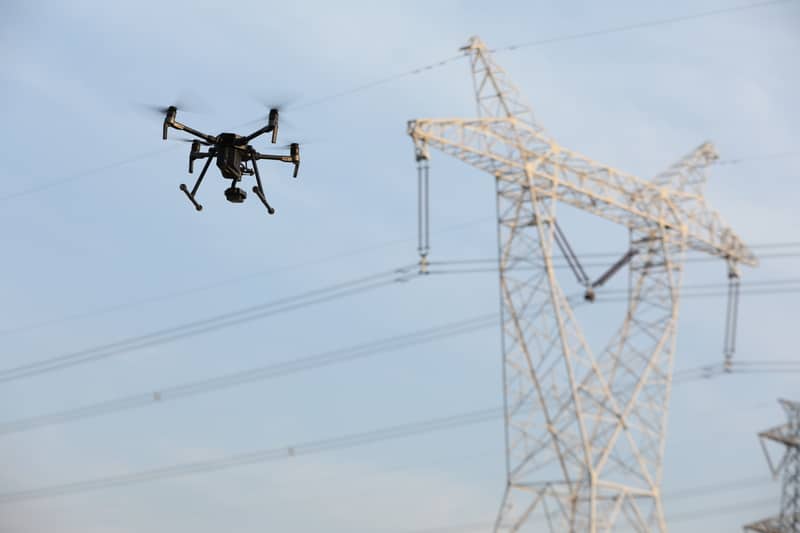
Drone-Based Utility Inspections That Reduce Risk and Downtime
Utility infrastructure inspections are high-stakes — aging assets, hard-to-reach locations, and tight regulatory timelines. Drone utility inspection lets you inspect more infrastructure in less time, with better data and without putting crews in hazardous positions. For electric utilities managing thousands of miles of transmission corridors and hundreds of substations, drones eliminate the need for bucket trucks, helicopter patrols, and live-line climbing on energized equipment.
Our pilots have completed over 10,000 utility inspections across power lines, substations, transmission towers, and distribution networks. We know what your engineering teams need and deliver it in a format they can use — whether that’s thermal anomaly reports for predictive maintenance programs or high-resolution imagery for vegetation management planning.
What We Deliver
Power line and transmission corridor patrols covering overhead conductors, insulators, crossarms, and support structures. We document condition across entire circuits, identifying damaged hardware, worn components, and potential failure points before they cause outages.
Substation and switchyard visual inspections that eliminate the need for scaffolding, boom lifts, or energized equipment access. Our pilots capture detailed imagery of transformers, breakers, disconnect switches, and bus work from safe standoff distances, allowing engineers to assess equipment condition without de-energizing facilities.
Vegetation encroachment and right-of-way surveys using high-resolution imagery and LiDAR when clearance measurements are required. We document tree growth, danger tree candidates, and vegetation that threatens minimum clearance distances, providing actionable data for trimming crews and contractors.
Thermal imaging of connections, transformers, and insulators using calibrated radiometric cameras that detect temperature differentials indicating loose connections, overloaded circuits, and failing components. Early detection prevents catastrophic failures and unplanned outages.
Pole and structure condition assessments, documenting woodpecker damage, rot, rust, foundation issues, and other structural degradation that compromises system reliability.
LiDAR-compatible deliverables when your project requires precise measurements, terrain modeling, or integration with GIS systems for line design and clearance analysis.
Why Utilities Are Adopting Drones
Traditional utility inspection methods rely on manual patrols, helicopter flights, and bucket truck access — each with limitations. Ground patrols miss details visible only from elevated positions. Helicopter inspections are expensive and weather-dependent. Bucket trucks require road access and extended crew time at each structure.
Drone utility inspection solves these problems. A single pilot can inspect miles of transmission corridor in a day, capturing consistent, high-resolution data at a fraction of the cost of helicopter patrols. Thermal imaging reveals problems invisible to the naked eye, enabling predictive maintenance strategies that prevent failures instead of reacting to them.
For substations and switchyards, drones eliminate the need to de-energize equipment or deploy personnel near live electrical infrastructure. Inspections happen faster, with less operational disruption, and without the arc flash and electrocution risks inherent in manual inspections of energized equipment.
Regulatory compliance is simpler too. NERC standards require vegetation management and equipment inspection on defined cycles. Drones accelerate these inspections while creating timestamped, geotagged documentation that supports compliance audits and regulatory filings.
Ideal For
Electric utilities and cooperatives managing transmission and distribution infrastructure across service territories spanning hundreds or thousands of square miles.
Transmission and distribution operators conducting routine inspection cycles, storm damage assessments, and post-maintenance verification.
Vegetation management teams identifying trim priorities, danger trees, and right-of-way encroachments that threaten service reliability and regulatory compliance.
Engineering and inspection firms providing contracted inspection services for utilities, requiring rapid deployment capabilities and deliverables compatible with client asset management systems.
Our Approach
Every flight follows utility-specific safety protocols including NERC compliance awareness, minimum approach distances for energized equipment, and coordination with system operators when inspecting substations or critical infrastructure. Our pilots understand the operational environment — they know to avoid inducing outages, coordinate with dispatch during inspections near critical loads, and recognize the difference between routine wear and conditions requiring immediate attention.
We’re fully insured with coverage limits appropriate for utility infrastructure work, maintain FAA Part 107 certifications, and have pilots experienced in utility corridor operations who understand transmission line construction, substation equipment, and the regulatory environment utilities operate within.
Deliverables include georeferenced imagery, thermal anomaly reports with temperature data, and annotated findings reports organized by severity. If you’re tracking asset condition over time, we provide comparison reports showing degradation trends across inspection cycles. The data integrates with common utility asset management platforms, or we deliver raw imagery and metadata for your internal analysis workflows.
Explore our other inspection services: cell tower inspections, solar panel inspections, wind turbine inspections, roof inspections, and agricultural drone services.
Operations follow NERC reliability standards awareness protocols and all pilots hold FAA Part 107 certification.