
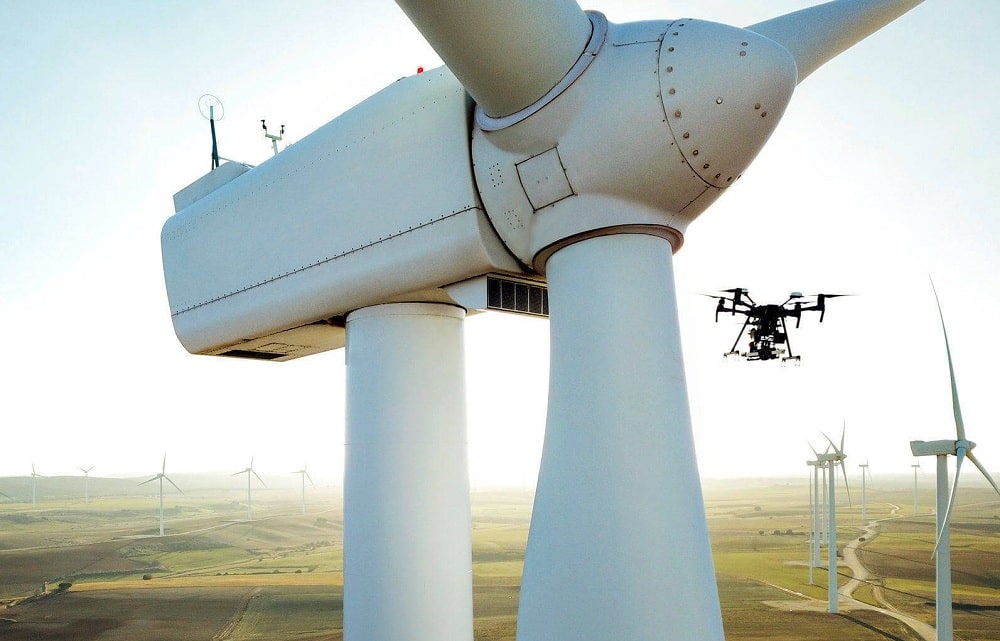
High-Resolution Blade Inspections Without Rope Access
Wind turbine blade inspections are critical for maintaining performance and extending asset life. Traditional methods require rope access teams or expensive crane setups — slow, risky, and costly. Drone wind turbine inspection captures high-resolution imagery of every blade surface from multiple angles, delivering the detail you need to assess damage and plan maintenance without taking turbines offline for extended periods.
For wind farm operators managing dozens or hundreds of turbines, the cost and scheduling complexity of traditional blade inspections create real operational challenges. Rope access requires specialized technicians, favorable weather windows, and turbine downtime that directly reduces revenue. Drone inspections eliminate these constraints while improving data quality and worker safety.
What We Deliver
High-resolution visual inspection of all blade surfaces, capturing leading edges, trailing edges, pressure sides, and suction sides from root to tip. Our imagery resolution reveals damage as small as individual gel coat cracks, providing the detail engineers need to assess structural integrity and plan repairs.
Leading edge erosion detection, documenting the progressive wear that reduces aerodynamic efficiency and cuts annual energy production. We map erosion severity across the blade span, supporting decisions about leading edge protection application or blade replacement timing.
Lightning strike and crack identification, locating impact damage, delamination, and structural cracks that compromise blade strength. Early detection prevents catastrophic failures and allows repairs during planned maintenance windows instead of emergency shutdowns.
Structured inspection reports with annotated imagery, organized by turbine and blade position. Each finding includes severity classification, GPS coordinates, and distance-from-tip measurements so maintenance crews can locate damage quickly. Reports document conditions for warranty claims, insurance assessments, and regulatory compliance.
Comparison data for tracking degradation over time, showing how damage progresses between inspection cycles. Understanding degradation rates helps optimize inspection frequency and maintenance scheduling, balancing inspection costs against failure risk.
Why Wind Farms Are Moving to Drones
Rope access inspection has been the wind industry standard, but the method has serious drawbacks. Technicians rappel down spinning towers or work from platforms while turbines are shut down, documenting damage with handheld cameras. The work is dangerous — fall protection is critical, and weather constraints limit inspection windows to calm conditions.
The process is slow too. Inspecting a three-blade turbine takes hours per unit. For a 100-turbine farm, that’s weeks of work coordinating technician schedules, managing turbine shutdowns, and waiting for suitable weather. Lost production during shutdowns compounds the cost.
Drone wind turbine inspection solves these problems. A single pilot can inspect multiple turbines per day, capturing complete blade coverage in a fraction of the time rope access requires. Turbines remain stopped during the inspection but for minutes instead of hours, minimizing production loss.
The data quality often exceeds rope access results. Drones capture consistent imagery from repeatable positions, making year-over-year comparison straightforward. Automated flight paths ensure complete coverage of all blade surfaces with no gaps. Image resolution reveals small cracks and erosion damage that technicians at arm’s length might miss.
Safety improvements are substantial. Eliminating rope access eliminates fall risk. Pilots operate from the ground in controlled conditions, removing personnel from hazardous at-height work environments entirely.
Ideal For
Wind farm operators and asset managers maintaining fleets of turbines across single or multiple sites, requiring regular inspection cycles to meet manufacturer warranty requirements and operational performance targets.
O&M service providers delivering contracted inspection and maintenance services for wind farm owners, needing rapid deployment capabilities and standardized reporting formats.
Insurance and warranty inspections, documenting damage for claims or verifying that blade conditions meet manufacturer warranty terms before expiration.
Pre-acquisition due diligence, assessing blade condition as part of wind farm purchase evaluations to quantify deferred maintenance liabilities and inform valuation.
Our Approach
Every inspection follows a standardized flight protocol ensuring consistent coverage and repeatable results. We document all blade surfaces from multiple angles, capturing overlap between images that supports detailed damage mapping. Flight altitude and camera settings are optimized for the resolution needed to detect early-stage damage.
Pilots are fully insured, FAA Part 107 certified, and experienced in wind turbine inspection operations. We understand the operational environment — coordination with site management for turbine shutdowns, adherence to site safety protocols, and recognition of damage types that require immediate attention versus routine maintenance.
Deliverables include high-resolution imagery organized by turbine and blade, annotated inspection reports with severity classifications, and georeferenced damage maps. If you’re tracking blade condition over time, we provide side-by-side comparisons showing damage progression between inspection cycles.
The economics favor drones. Eliminating rope access reduces inspection costs while improving safety. Faster inspections mean less lost production. Better data supports more informed maintenance decisions, reducing emergency repairs and extending component life. For most operations, the ROI is clear within the first inspection cycle.
Explore our other inspection services: cell tower inspections, utility inspections, solar panel inspections, roof inspections, and agricultural drone services.
Our inspection protocols align with ASTM E2841 standards for wind turbine condition assessment. All pilots hold FAA Part 107 certification.