If you’ve been following the commercial drone industry, you’ve probably heard the buzz around three letters: BVLOS. Beyond Visual Line of Sight. It’s the single biggest regulatory shift in commercial drone operations since Part 107 launched in 2016 — and it’s happening right now in 2026.
The FAA’s proposed Part 108 rule is set to change the game for how drones are used across agriculture, telecom, utilities, and infrastructure. Here’s what you need to know and why it matters if your business uses — or is considering — drone services.
What Is BVLOS and Why Does It Matter?
Under current FAA Part 107 rules, commercial drone pilots must keep their aircraft within visual line of sight at all times. That means the pilot needs to be able to see the drone with their own eyes during the entire flight. No binoculars, no monitors — just eyes on the aircraft.
This works fine for small jobs. But it creates a hard ceiling on what commercial drones can do. If you’re scanning a 1,000-acre farm, the pilot has to reposition constantly to keep the drone in sight. If you’re inspecting a 10-mile utility corridor, you need a crew at multiple positions along the route. The line-of-sight requirement adds time, labor, and cost to every mission.
BVLOS removes that limitation. It allows drones to fly beyond the pilot’s visual range — autonomously following pre-programmed routes, covering massive areas in a single flight, and operating with minimal ground crew. It’s the difference between a useful tool and a transformative one.
What Part 108 Proposes
In August 2025, the FAA published a proposed performance-based framework for BVLOS operations. Rather than prescribing exactly what technology operators must use, Part 108 focuses on outcomes — can your system detect and avoid other aircraft? Can it operate safely without a visual observer?
Key elements of the proposed framework include:
- Performance-based standards for detect-and-avoid (DAA) capability, rather than mandating specific hardware
- Airworthiness pathways designed specifically for unmanned aircraft — not adapted from manned aviation rules
- Scalable authorizations that allow operators to expand operations without individual waivers for every flight
- Integration with airspace management systems to safely share low-altitude airspace with manned aircraft
The FAA has been building toward this through its BEYOND program, which has already granted limited BVLOS approvals for power-line inspections, infrastructure monitoring, and other use cases. Part 108 is designed to take what’s been proven in those programs and make it available at commercial scale.
It’s important to note that Part 108 is still in the rulemaking process. Final details may change. But the direction is clear: routine BVLOS operations are coming, and the regulatory groundwork is being laid right now.
What This Means for Agriculture
Agriculture stands to be one of the biggest beneficiaries of BVLOS operations. Here’s why:
Coverage. Under current rules, scanning a large farm requires multiple flights with constant repositioning. With BVLOS, a single drone can cover hundreds or even thousands of acres in one mission, following a pre-programmed route across entire fields without the pilot needing to keep the aircraft in sight.
Speed. What currently takes days of fieldwork could be accomplished in hours. For time-sensitive operations like mid-season crop scouting, that speed translates directly to earlier intervention and better outcomes.
Cost. Fewer flights, fewer crew hours, and less repositioning means lower per-acre costs for aerial scanning services. As BVLOS operations scale, drone-based crop monitoring becomes accessible to operations of all sizes — not just the largest farms.
Frequency. When flights are faster and cheaper, you can fly more often. Weekly or even daily monitoring becomes practical, giving agronomists and farm managers a continuous picture of crop health rather than periodic snapshots.
What This Means for Telecom and Infrastructure
Cell tower inspections, utility corridor surveys, and infrastructure monitoring all face the same challenge: the assets are spread across large geographic areas, often in difficult terrain.
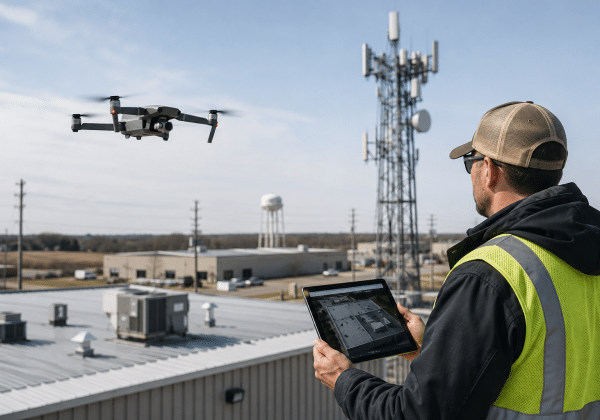
Tower inspections. Today, inspecting a portfolio of cell towers requires deploying a drone crew to each site individually. BVLOS could enable route-based inspection flights covering multiple towers in a single mission, dramatically reducing the time and cost per site.
Utility corridors. Power lines, pipelines, and rail corridors stretch for miles. BVLOS allows a drone to fly the entire corridor in one continuous flight, capturing consistent data without gaps or repositioning delays.
Emergency response. When storms, floods, or other events damage infrastructure, BVLOS-capable drones can survey large affected areas quickly — providing damage assessments before ground crews can even access the sites.
What This Means for Businesses Considering Drone Services
If you’ve been on the fence about incorporating drone data into your operations, the BVLOS shift makes the case even stronger. Here’s what to keep in mind:
Costs are coming down. As BVLOS reduces the labor and logistics overhead of drone operations, service pricing will become more competitive — especially for large-area and recurring projects.
Data quality is going up. Automated, pre-programmed flight paths produce more consistent data than manually piloted flights. That means better maps, more reliable crop health indices, and more accurate inspection reports.
Now is the time to establish a baseline. Businesses that start building aerial data into their decision-making now will be positioned to take full advantage of BVLOS capabilities as they become available. Having historical data to compare against makes every future flight more valuable.
Choose a provider who’s preparing. Not every drone operator is positioned for the BVLOS era. Look for providers with established operations, proper certifications, and the infrastructure to scale when the new rules take effect.
How AeroDeploy Is Preparing
At Aero Deploy UAV, we’ve been providing professional commercial drone services since 2012 — long before Part 107 even existed. We’ve built our operations to adapt as the regulatory landscape evolves, and BVLOS is no exception.
We’re actively monitoring the Part 108 rulemaking process, investing in the training and technology needed to operate under the new framework, and working with our clients to plan for expanded capabilities as they become available.
Whether you need aerial crop scanning this season under current Part 107 rules, or you’re planning ahead for large-scale BVLOS operations, we’re ready to help.
Get in touch to talk about how drone services can work for your operation — today and as the rules evolve.