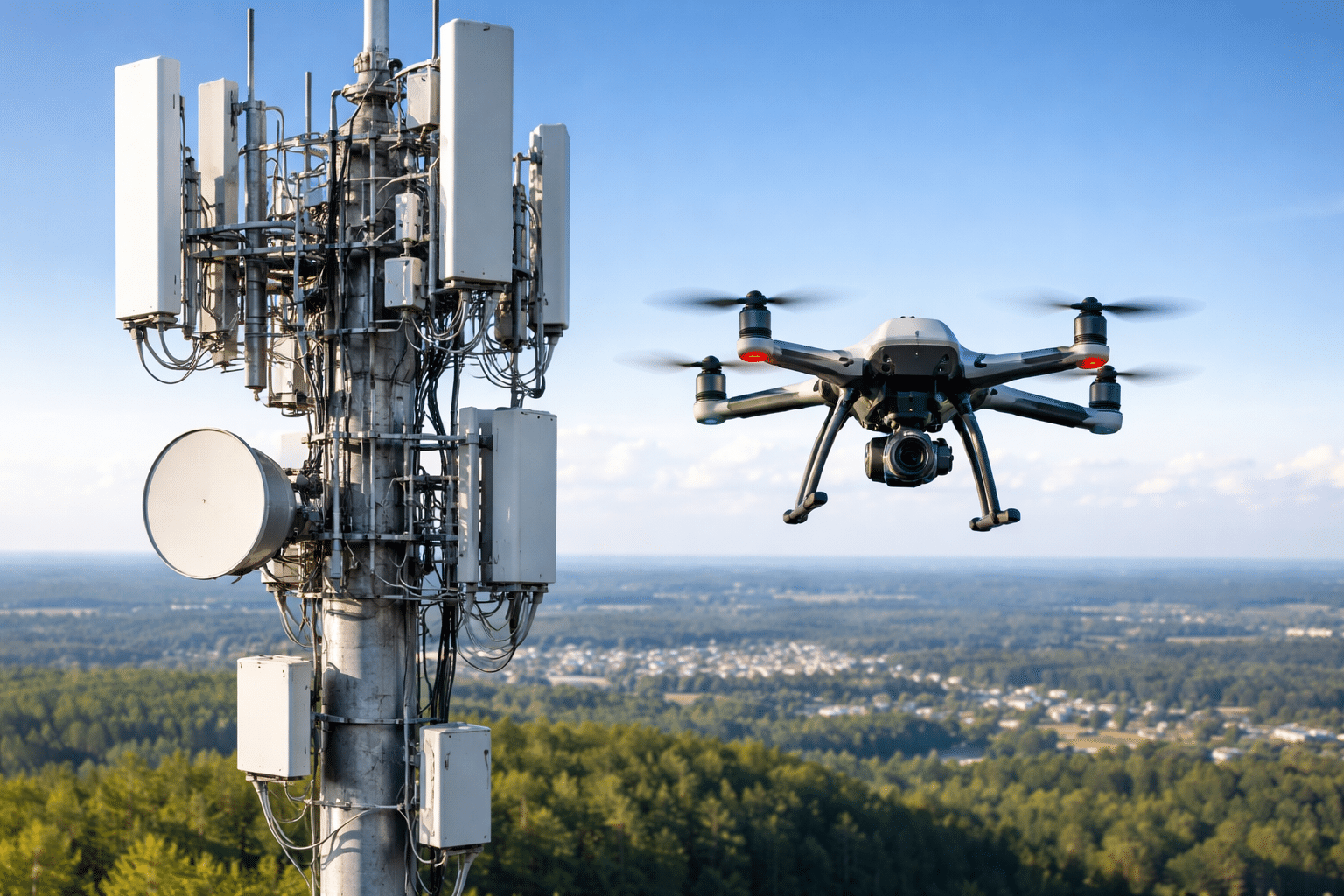
We’ve inspected thousands of cell towers across the United States as part of our telecom survey services, from guyed towers in rural Oklahoma to rooftop installations in downtown Chicago. The process looks simple from the ground—fly a drone around a tower and take pictures—but effective tower inspections require systematic planning, precise execution, and detailed documentation that holds up when maintenance crews are 200 feet in the air acting on your findings.
Here’s exactly how the process works.
Pre-Inspection Planning (1-3 Days Before)
Every tower inspection starts with desktop analysis before we leave the office.
Airspace authorization: Most cell towers require FAA airspace authorization, especially if they’re near airports or in controlled airspace. We file for authorizations through LAANC (Low Altitude Authorization and Notification Capability) for towers in supported airspace, or via DroneZone waiver requests for more complex situations. This happens days or weeks before the inspection, not the morning of.
Site research: We review tower registration data from the FCC’s Antenna Structure Registration database, which tells us official height, lighting requirements, and ownership. Google Earth gives us a preliminary view of access roads, nearby obstacles, and surrounding terrain. If you’re the tower owner, we’ll request structural drawings to understand mount configurations and antenna arrangements.
Weather forecasting: We’re checking more than whether it’s raining. Wind speed at altitude, visibility, temperature (batteries perform poorly below 40°F), and forecast stability all factor into go/no-go decisions. If the forecast shows gusts above 25mph, we’re rescheduling.
Equipment selection: Tower inspections typically use our Autel EVO II Dual with 8K visual camera and 640×512 thermal sensor (the same thermal capability we use for solar panel inspections), or DJI M300 RTK for larger structures requiring precision positioning. We fly with multiple battery sets (4-6 batteries minimum) and bring backup aircraft to every job.
On-Site Setup (30-45 Minutes)
Site walk: Before we unpack any equipment, we walk the tower base looking for hazards—guy wire anchors, fence lines, overhead power distribution, cellular equipment shelters that might interfere with GPS. We establish takeoff/landing zones clear of obstacles with good line-of-sight to the tower.
Safety briefing: Our two-person crews (pilot and visual observer) review the flight plan, communication protocols, and emergency procedures. Cell towers often have active RF emissions. While Part 107 operations don’t typically get close enough to antennas for RF exposure to be a concern, we brief on the specific tower’s power levels and maintain appropriate clearances.
Ground control point placement (if survey-grade positioning is required): For towers where we’re providing dimensional data for structural analysis, we place GCPs using RTK GNSS with centimeter-level accuracy.
The Inspection Flight Pattern
Orbit pattern (primary): We fly automated orbital patterns around the tower at multiple altitudes, capturing the entire structure in overlapping imagery. Typical pattern for a 200-foot tower:
- Base orbit at 20 feet AGL
- Mid-section orbit at 100 feet AGL
- Top section orbit at 180 feet AGL
- Above-tower imaging at 220 feet AGL (looking down at top mount)
Each orbit captures 60-100 images with 70-80% overlap, ensuring we have complete coverage from all angles. Camera settings are locked—fixed ISO, fast shutter speed (1/500 or faster to eliminate motion blur), focus set to infinity.
Detail passes (secondary): After completing the primary orbit pattern, we make targeted passes for close-up inspection of specific components:
- Antenna mounts and coax connections
- Ladder sections and safety climb hardware
- Guy wire terminations and turnbuckles
- Tower leg welds and bolt connections
- Ice shields and cable management
- Lighting system components
These detail passes are manual flight, with the visual observer directing the pilot to specific areas of interest.
Thermal imaging pass: If the tower owner has requested thermal data (common for identifying failing feed lines or loose electrical connections — similar to what we do in solar farm inspections), we make an additional pass during late afternoon when thermal signatures are most pronounced.
Total flight time: 25-40 minutes for a typical 200-foot self-supporting or guyed tower. Monopoles are faster (15-25 minutes) due to simpler geometry.
Data Capture Specifications
Visual imagery: 8K resolution (7680 x 4320 pixels) in RAW+JPEG format. File sizes are large—a typical tower inspection generates 15-25GB of image data.
Thermal imagery: 640×512 radiometric thermal, capturing actual temperature data in every pixel, not just a color representation. This matters because you can analyze the data later to identify temperature anomalies that might not be visually obvious in the field.
Metadata: Every image includes GPS coordinates, altitude, gimbal angle, timestamp, and camera settings. This metadata allows us to reconstruct the exact viewing geometry for any image, which is essential when maintenance crews need to locate specific defects.
Post-Flight Processing (1-3 Days)
Image review and tagging: Every image is reviewed, and defects are tagged with severity classifications:
- Critical: Structural damage, loose bolts on critical connections, failing guy wires
- Priority: Rust degradation, paint failure exposing metal, bent antenna mounts
- Monitor: Minor cosmetic issues, early-stage rust, cable management problems
Photogrammetry processing (if requested): We import images into Pix4D or RealityCapture to generate 3D models and orthomosaic imagery. This creates a measurable 3D representation of the tower where engineers can extract dimensional data without field measurements.
Report generation: Final deliverables include:
- Annotated photo report with defect locations marked on tower elevation drawings
- High-resolution image library organized by tower section and component
- Thermal analysis report (if applicable)
- 3D model or point cloud (if survey-grade data was requested)
- Executive summary with defect counts and recommended actions
What We’re Actually Looking For
Structural issues: Cracked welds, bent or deformed members, missing or loose bolts, corrosion that’s compromised structural integrity. These are the findings that trigger immediate maintenance.
Antenna and transmission line problems: Loose mounts, damaged coax lines, improperly secured feeders, ice bridge damage. These affect network performance and can create additional wind load.
Corrosion and coating failure: We document rust patterns and paint degradation. Tower coating is expensive to repair, so tracking degradation helps owners budget for maintenance before it becomes critical.
Guy wire condition: Fraying, broken strands, turnbuckle condition, anchor integrity. Guy wire failure can take down an entire tower.
Safety equipment: Ladder condition, safety climb systems, platforms and work areas. Climbers depend on this equipment—defects here are high priority.
Compliance and Documentation
All AeroDeploy pilots hold Part 107 Remote Pilot Certificates, and we maintain $5M liability coverage specific to commercial tower work. Our inspection reports are used by structural engineers for tower analysis and by insurance carriers for coverage decisions, so documentation quality matters.
We archive all raw data for five years, which lets tower owners come back years later and request re-analysis of historical data if new problems emerge.
Typical Turnaround
From scheduling to final deliverable: 5-10 business days for standard inspections, faster if you need expedited analysis. We’ve delivered preliminary findings same-day when storm damage required immediate assessment for emergency repairs.
When Drones Don’t Replace Climbers
Drone inspections excel at visual documentation and defect identification. They don’t replace hands-on inspection when you need to physically test bolt torque, check grounding connections with test equipment, or perform minor repairs during the inspection.
Our reports often inform climbing work—crews climb with a specific punch list of items to repair rather than spending expensive tower time discovering problems. That’s more efficient than traditional climb-and-inspect approaches where you don’t know what you’ll find until someone is 200 feet up.
Get Your Towers Inspected
Whether you’re managing a single site or a regional portfolio, we can provide detailed tower documentation faster and safer than traditional inspection methods.
Contact us for telecom tower inspection →
Related Reading
- Drone Inspection Cost vs Traditional Methods — See how drone cell tower inspections compare on price, speed, and data quality.
- AI in the Drone Industry: How It’s Actually Being Used — How automated object detection is speeding up tower inspection review.
- NDVI Crop Monitoring with Drones — Another way we’re using drone data to deliver actionable insights.
Ready to schedule a tower inspection? Contact us →